




The Bachelor of Pharmacy (B.Pharm) is an undergraduate degree programme for students interested in medicines, pharmaceutical sciences, healthcare and the pharmaceutical industry. It provides an academic foundation in how medicines are developed, formulated, analysed and used.
For students planning to pursue a B.Pharm course in Nashik, understanding the curriculum is an important step before choosing a college.
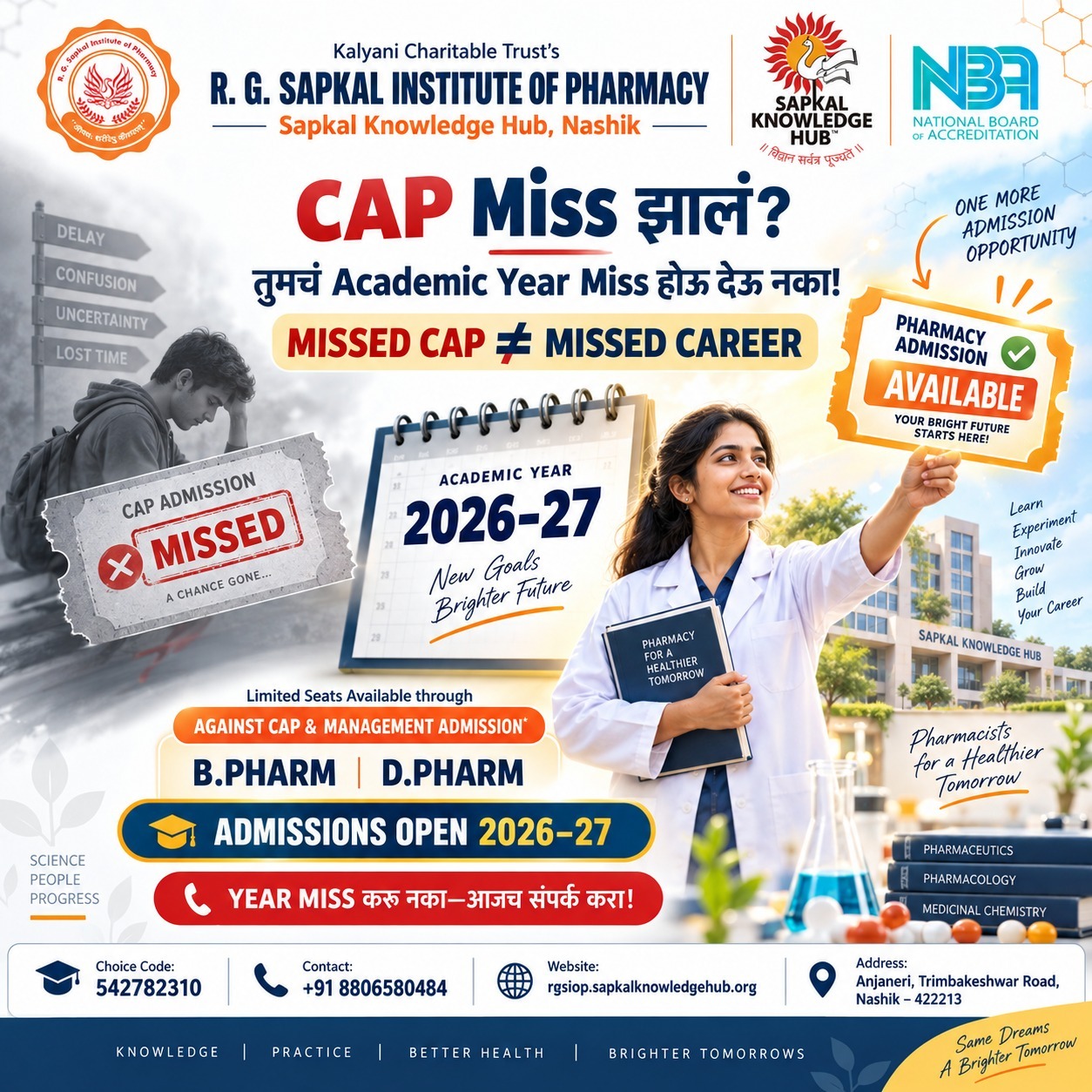
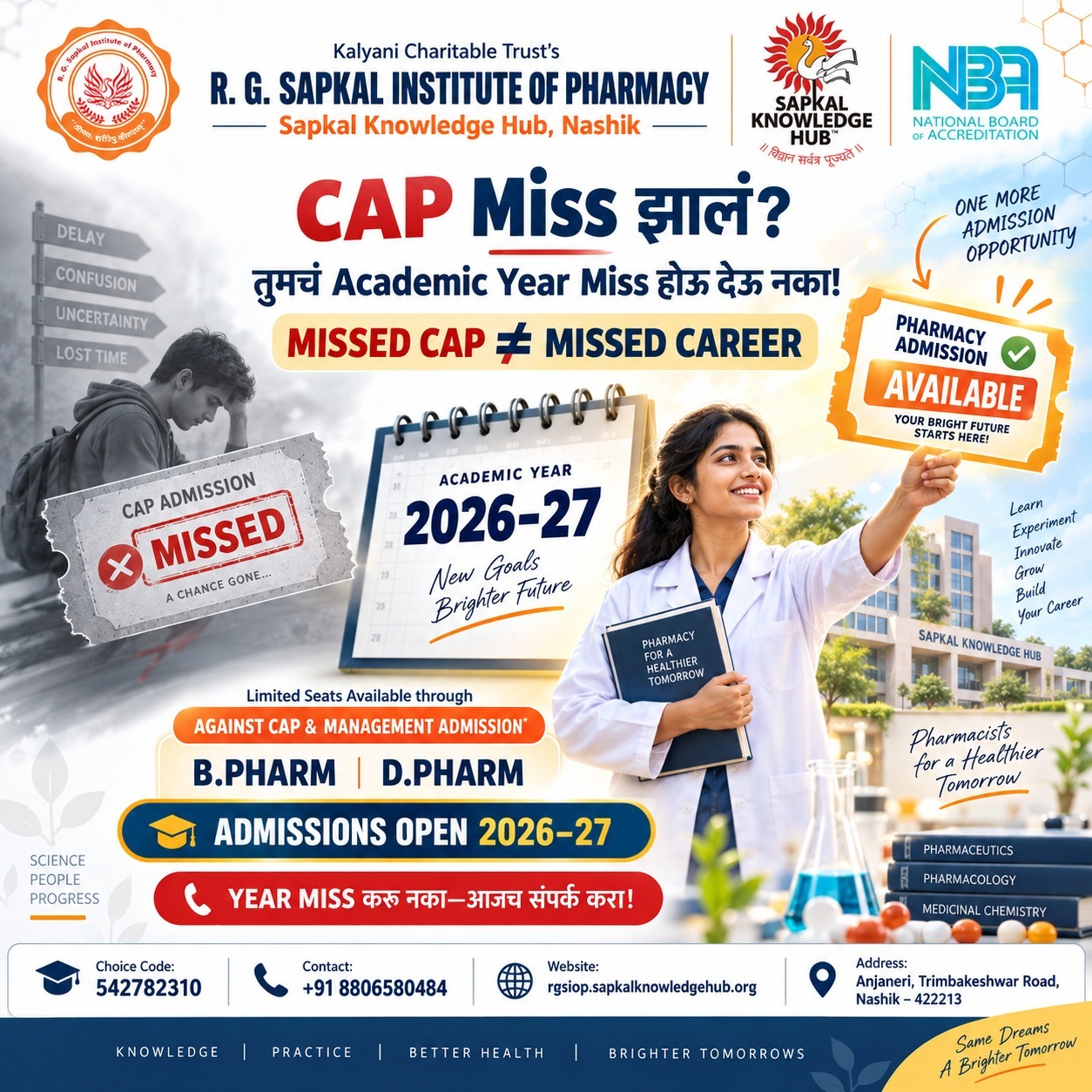
At R. G. Sapkal Institute of Pharmacy (RGSIOP), Nashik, the B.Pharm programme is offered as a four-year undergraduate course. It covers core pharmaceutical subjects, combining scientific concepts with laboratory-based learning.
This guide explains the main areas of the B.Pharm curriculum, the skills students develop and how the subjects relate to different professional fields.
What Is the B.Pharm Course?
B.Pharm stands for Bachelor of Pharmacy. It is a professional undergraduate degree in pharmaceutical sciences.
The programme introduces students to the scientific principles involved in medicines, including their composition, preparation, testing, biological effects and appropriate use.
According to the Pharmacy Council of India (PCI), the established B.Pharm programme is structured over four academic years, traditionally divided into eight semesters.
The course combines theoretical study with practical components to develop pharmaceutical knowledge, analytical skills and an understanding of professional responsibilities.
At RGSIOP, the B.Pharm programme is listed among the institute's academic offerings. Students should consult the institute's official syllabus for the requirements applicable to their admission batch.
Understanding the Main Subjects in the B.Pharm Curriculum
The B.Pharm curriculum covers several branches of pharmaceutical science. Each subject helps students understand a different aspect of medicines and healthcare.
1. Pharmaceutics
Pharmaceutics focuses on the formulation, preparation and delivery of medicines.
Students learn fundamental concepts related to pharmaceutical dosage forms, formulation methods and factors that influence drug delivery.
The subject helps explain why medicines are available in different forms, including tablets, capsules, liquids, creams and injections.
It provides a foundation for understanding pharmaceutical formulation and manufacturing processes.
2. Pharmaceutical Chemistry
Pharmaceutical Chemistry deals with the chemical properties, composition, structure and analysis of substances used in medicines.
The subject helps students understand the chemical principles underlying pharmaceutical compounds and their applications.
It also establishes a foundation for more advanced learning in medicinal chemistry and pharmaceutical analysis.
Knowledge of pharmaceutical chemistry is relevant to drug development, testing and quality-related functions in the pharmaceutical industry.
3. Pharmacology
Pharmacology is the study of drugs and their effects on living organisms.
Students explore how drugs interact with biological systems, how they produce their effects and why unwanted effects may occur.
The subject provides an understanding of drug actions, therapeutic uses and important principles of medicine safety.
Pharmacology is especially relevant to students interested in healthcare, pharmaceutical research and drug safety.
4. Pharmacognosy
Pharmacognosy is concerned with medicines and biologically active substances obtained from natural sources.
Students study the identification, properties and pharmaceutical relevance of materials derived from plants and other natural sources.
The subject helps build an understanding of natural products used in pharmaceutical science and their role in drug research.
5. Pharmaceutical Analysis
Pharmaceutical Analysis focuses on the scientific methods used to identify, measure and examine pharmaceutical substances.
Students develop an understanding of analytical procedures and the principles behind pharmaceutical testing.
This area of study is important because the quality and consistency of medicines depend on appropriate analytical assessment.
Pharmaceutical analysis also provides foundational knowledge relevant to quality control and laboratory-based pharmaceutical work.
6. Human Anatomy and Physiology
Human Anatomy and Physiology introduces students to the structure and functions of the human body.
Understanding organs, tissues and biological systems is important for studying how medicines interact with the body.
This foundational subject supports later learning in pharmacology and other biomedical areas within pharmacy education.
How the B.Pharm Curriculum Progresses Over Four Years
The B.Pharm course is designed to help students progress from fundamental scientific knowledge towards more specialised pharmaceutical subjects.
The exact sequence and names of subjects depend on the applicable approved syllabus.
|
Stage of study |
Main learning focus |
|
First year |
Foundational pharmaceutical and biomedical sciences |
|
Second year |
Development of core pharmaceutical knowledge |
|
Third year |
More specialised pharmaceutical subjects and applications |
|
Fourth year |
Advanced topics, professional applications and applicable academic requirements |
This is a general overview of the learning progression, not a substitute for an official semester-wise subject list.
Students should consult the current syllabus issued by the institute and applicable university for exact subjects, credits, practical requirements and examination patterns.
Importance of Practical Learning in B.Pharm
Pharmacy education involves both theoretical knowledge and practical understanding.
Laboratory-based learning enables students to connect classroom concepts with pharmaceutical procedures and scientific methods.
Depending on the prescribed syllabus and laboratory activities, practical coursework may involve pharmaceutical preparation, chemical analysis, observation, calculations and experimental documentation.
Practical learning helps students develop important competencies such as:
- Careful observation and analytical thinking
- Accurate measurement and calculation
- Scientific record-keeping
- Laboratory safety awareness
- Understanding experimental procedures
- Interpreting observations and results
These skills provide a foundation for further education and professional work in pharmacy-related fields.
B.Pharm Curriculum and the National Education Policy 2020
The Pharmacy Council of India has published a B.Pharm syllabus for 2026 aligned with the National Education Policy (NEP) 2020.
The syllabus describes an approach that places importance on pharmaceutical knowledge, practical competencies, research orientation and professional development.
It also recognises the growing relevance of digital technologies and artificial intelligence in pharmaceutical science.
Areas addressed by the updated curriculum framework include:
Scientific and pharmaceutical knowledge: Developing an understanding of pharmaceutical sciences and their applications.
Practical and experiential learning: Connecting academic concepts with appropriate practical work and professional experiences.
Research and innovation: Encouraging scientific enquiry, problem-solving and evidence-based approaches.
Digital and technological awareness: Introducing the relevance of modern technologies, including AI and data analytics, to pharmaceutical fields.
Professional ethics: Understanding responsibilities related to medicines, patient safety and professional conduct.
RGSIOP provides a link to the PCI's 2026 B.Pharm syllabus on its official academic syllabus page.
Students should confirm which syllabus and regulations apply to their particular academic batch, as implementation requirements may differ.
Skills Students Can Develop During B.Pharm
The B.Pharm curriculum aims to help students develop knowledge and abilities relevant to pharmaceutical education and professional practice.
Scientific and Analytical Skills
Students learn to examine pharmaceutical concepts using scientific principles, calculations, observation and analytical methods.
Technical Understanding
Studying pharmaceutics, pharmaceutical chemistry and analysis helps students understand concepts relevant to formulation, testing and pharmaceutical processes.
Communication Skills
Effective communication is important in pharmacy-related environments, including healthcare, research and pharmaceutical organisations.
Problem-Solving Abilities
Students learn to apply scientific concepts to academic questions and practical pharmaceutical problems.
Professional and Ethical Awareness
Pharmaceutical education also involves understanding responsible conduct, medicine safety and the importance of following applicable professional standards.
Career Pathways Related to B.Pharm Studies
The B.Pharm curriculum introduces students to different areas of pharmaceutical science that relate to several career pathways.
After graduation, depending on their qualifications, interests and applicable employment or registration requirements, students may explore opportunities in:
- Pharmaceutical manufacturing and production
- Quality control and quality assurance
- Pharmaceutical research and development
- Clinical research
- Regulatory affairs
- Hospital and community pharmacy
- Pharmaceutical sales and marketing
- Drug safety and pharmacovigilance
Students may also consider postgraduate education or specialised training according to the eligibility requirements of their chosen programme.
Completing a B.Pharm degree does not automatically guarantee employment in a particular role. Career opportunities depend on relevant skills, qualifications, experience and available positions.
Studying B.Pharm at R. G. Sapkal Institute of Pharmacy, Nashik
R. G. Sapkal Institute of Pharmacy is located at Sapkal Knowledge Hub, Anjaneri-Wadholi, Trimbakeshwar Road, Nashik.
The institute offers a four-year B.Pharm programme and publishes academic information through its official website.
Its B.Pharm course information covers important pharmaceutical areas, including Pharmaceutics, Pharmaceutical Chemistry, Pharmacology, Pharmacognosy and pharmaceutical analysis.
Students considering admission can review the institute's academic pages for course information, published syllabus documents, eligibility requirements and admission procedures.
For detailed programme information, visit the official RGSIOP B.Pharmacy page.
Understanding the B.Pharm curriculum helps students gain a clearer picture of what they will study during their pharmacy education.
The programme covers foundational biomedical sciences, pharmaceutical formulation, drug chemistry, pharmacology, natural products and pharmaceutical analysis.
These subjects collectively support the development of scientific knowledge, practical skills and professional awareness.
For students exploring B.Pharm education in Nashik, reviewing the latest approved syllabus is an important part of making an informed academic decision.
Prospective students can visit the R. G. Sapkal Institute of Pharmacy website for further information about the B.Pharm programme.
Frequently Asked Questions About the B.Pharm Curriculum
1. What is the duration of the B.Pharm course at RGSIOP?
RGSIOP lists B.Pharm as a four-year undergraduate programme. Students should refer to the applicable regulations for detailed academic requirements.
2. What are the main subjects in the B.Pharm curriculum?
Important subjects include Pharmaceutics, Pharmaceutical Chemistry, Pharmacology, Pharmacognosy, Pharmaceutical Analysis, and Human Anatomy and Physiology, along with other subjects in the prescribed syllabus.
3. Does the B.Pharm curriculum include practical subjects?
Yes. B.Pharm education includes theoretical and practical components, with laboratory work prescribed under the applicable curriculum.
4. Is B.Pharm related to pharmaceutical research?
Yes. B.Pharm provides foundational knowledge in pharmaceutical sciences, analysis and drug-related subjects that can support further study or career development in pharmaceutical research.
5. Where can students find the official B.Pharm syllabus at RGSIOP?
Students can visit the RGSIOP B.Pharmacy syllabus page, which provides a link to the published B.Pharm syllabus.
6. Does the B.Pharm curriculum cover pharmaceutical industry topics?
Yes. Areas such as pharmaceutical formulation, chemistry, analysis and pharmacology provide knowledge relevant to various pharmaceutical industry functions.
7. Is the B.Pharm 2026 syllabus applicable to every student?
Not necessarily. The PCI has published a 2026 syllabus aligned with NEP 2020, but students should confirm the applicable curriculum with RGSIOP for their admission batch and university regulations.

